f
Cart
Cart
No Product
Go find the products you like.




Liriodendron tulipifera
Saddle-Shaped Foliage | Conical Form | Bright Yellow Autumn Leaves
Free 2-Year Rooted & Thriving Guarantee
Grown, Packed, Delivered - To Your Door
Choose a Size


Guarantee
Shipping
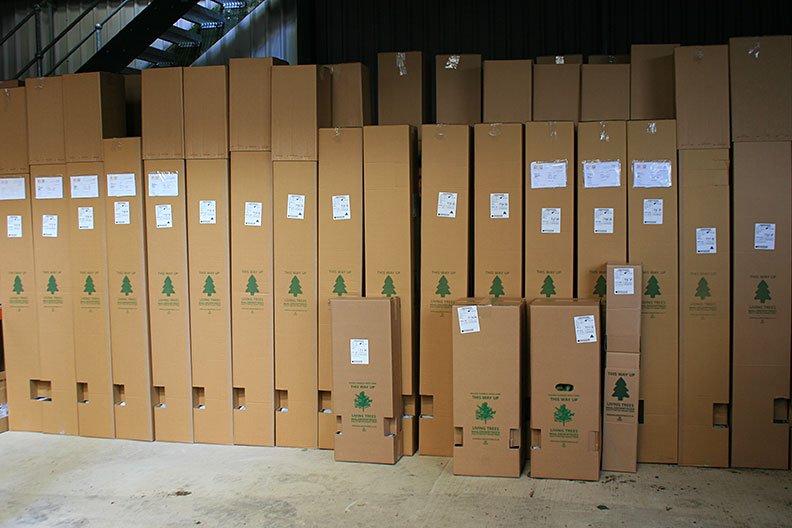
Here at Mail Order Trees, getting your trees and plants to you quickly and in perfect condition is our top priority. A great feature of our specially designed cardboard boxes is that they are 100% recyclable, which will help to reduce your carbon footprint even further.
We have a standard flat rate charge of £9.95 per consignment (including VAT) to England and Wales so the more you buy, the more you save! Prices for Scotland, Grampian, the Highands can be calculated in the checkout area. Unfortunately we are unable to ship to any other locations aside from these. This means we do not ship to Isle of Wight, Channel Islands, Northern Ireland/Ireland and any Scottish Islands.
Our usual delivery time is up to 7-10 working days, excluding weekends and bank holidays. We will, as ever, aim to stick to our usual timescale but please be aware that this may not always be possible. Please take the time to fill out the special instructions box in the checkout area with the details of a neighbour or safe place that your trees can be left. Every effort will be made to make deliveries in this time or on a date requested by you.
Mail-Order-Trees cannot be held responsible for delayed deliveries due to factors beyond our control such as Public Holidays or adverse weather conditions which make it impossible to lift bare-rooted trees. In cases such as these, you will be notified.
We can only deliver to physical addresses and not to PO boxes. A complete address including correct postcode must be provided. Incorrect postcodes cause more delays than omitting the postcode altogether.
Mail-Order-Trees cannot be held responsible for orders not received if an incorrect address is provided. It will also be necessary to give us details of where to place items should you be out when the delivery arrives. Mail-Order-Trees cannot be responsible for items lost if we have followed your instructions. A contact telephone number can also be very useful to our courier.

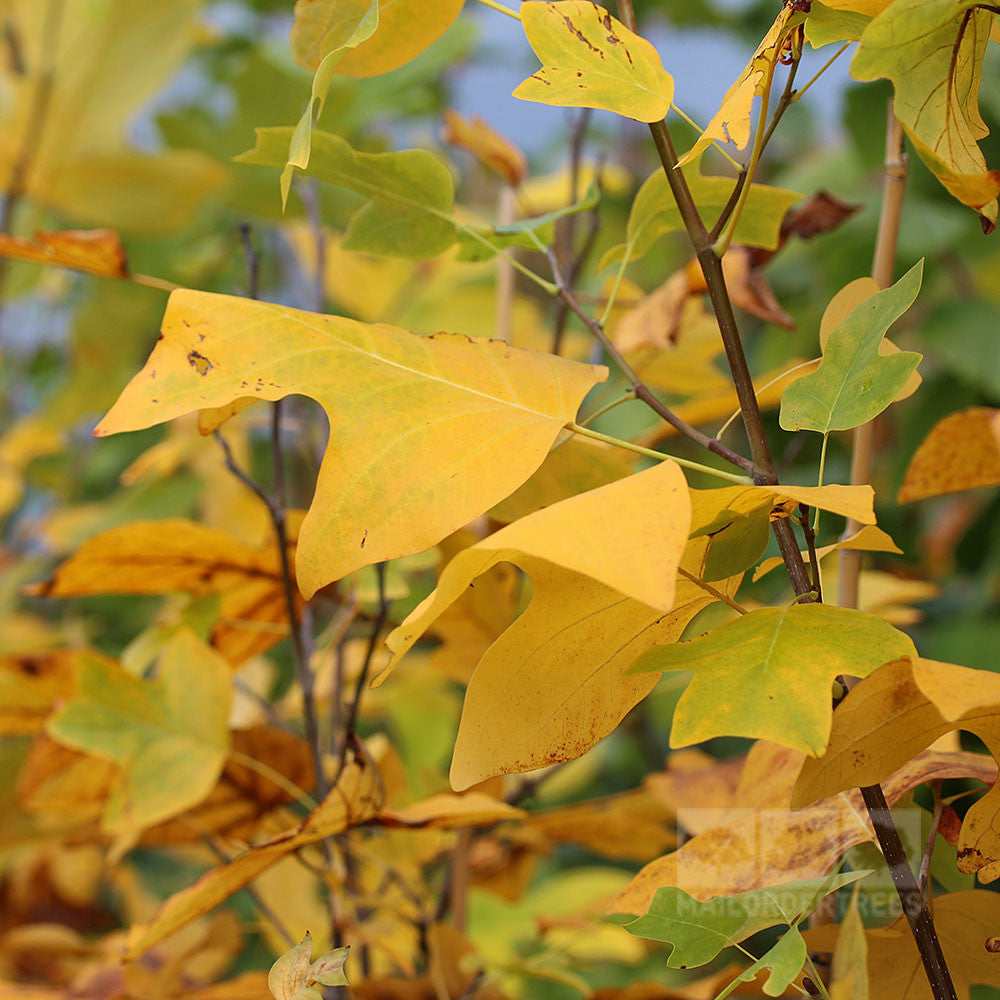
Large superb saddle-shaped dark green foliage, turning bright yellow in autumn. In summer, when the tree is in full foliage, mature trees produce tulip-shaped, green flowers. A conical-shaped tree which lends itself to specimen planting in grass.
Common Name: Tulip Tree
Latin Name: Liriodendron tulipifera
Special features: Foliage turns rich butter-yellow in autumn.
Height in 20 Years:

Width in 20 Years:

Growth Habit:
Planting Position:

Weather Exposure:

Hardiness:


Soil Type:

Soil Ph:

Special Features: